Data & Ethics
How we think about ownership, access, and the responsibility that comes with building infrastructure for scientific knowledge.
Zero Trust is not a setting
Most platforms add security controls on top of an architecture that was not built with them in mind. We went the other direction. Zero Trust is the starting assumption: no connection is trusted by default, no service gets access because it looks familiar, and no user inherits permissions just because they are inside the system.
Every request, whether it comes from a researcher uploading a dataset, a pipeline pulling from storage, or an AI agent running an analysis, goes through explicit verification. Every action leaves a trace. There are no back doors, no implicit grants, and no "trusted internal network" that bypasses the rules.
The practical result is that even if one part of the system were ever compromised, it would not cascade. The blast radius of any incident is contained by design, not by hope.
The five principles
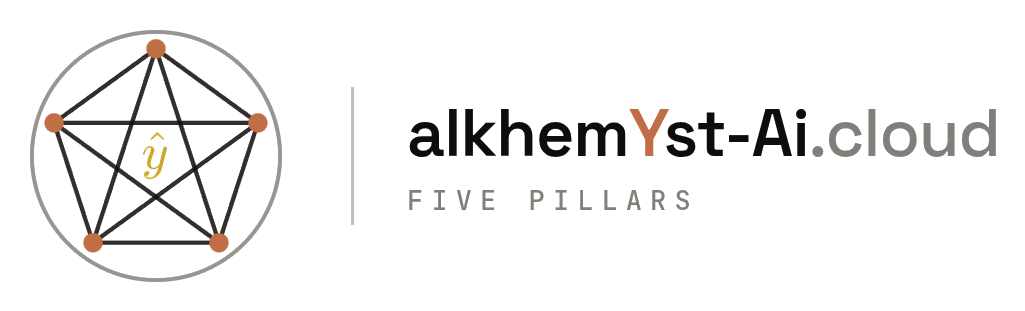
Click any node in the diagram to read the full principle. These are not aspirational goals. They are built into how the system behaves.
Who owns the data
The institution
Your university or research laboratory holds full ownership of everything it creates on AlkhemYst-Ai.cloud. Datasets, pipeline configurations, model artifacts, experiment records, and publications, all of it belongs to the institution. Not to us, not to any third party, and not to the researchers who happen to be working there at a given time.
The researcher
Within your institution, individual researchers own their own work in the sense that it is attributed to them and access- controlled at the project level. A researcher leaving an institution does not take the institution's data with them, but their contributions remain attributed and auditable.
Collaboration boundaries
When two institutions agree to collaborate, they define exactly what is being shared, in what direction, and with what permissions. A collaboration is scoped to a specific resource: a dataset, a pipeline, a research project. The owning institution can revoke that access at any moment. Nothing persists beyond the agreed terms.
How the AI agents work
Most AI tools you have used learned from large collections of data that included work from other people, sometimes without those people knowing. We built our agents differently, because we think that is the only honest way to serve research institutions.
The agents on AlkhemYst-Ai.cloud hold their knowledge in structured knowledge graphs. These graphs are built from open, curated scientific sources, published methodologies, domain-specific patterns, analytical frameworks, and documented best practices across disciplines. They are not built from anything your team stores on the platform.
When an agent helps you design a pipeline, interpret an anomaly, or suggest a hyperparameter range, it reasons from that graph. It draws connections, applies known patterns, and surfaces relevant approaches, all from the knowledge it was given at build time, not from observing other researchers.
Your own institution's historical data does play a role: the agents can analyse patterns in your past experiments and pipelines to help you understand your own evolution. But that context stays inside your workspace. It is never shared, never pooled with other institutions, and never fed back into the underlying graph.
How collaboration works
Research thrives on collaboration, but sharing between institutions is exactly where data ethics is usually lost. On AlkhemYst-Ai.cloud, nothing is ever shared by default, by accident, or by a setting someone forgot about. Every step of a collaboration is explicit, recorded, and reversible.
Institutions are invisible to each other until they switch on "Ready for Collaboration". Only then do they appear in the partner directory, and unticking the box delists them instantly.
A collaboration starts with a written invitation to the partner's administrator, with the intended scope stated up front. Both parties are on record from the first moment.
Only an administrator or principal investigator of the invited institution can accept. Nothing is visible to the partner before acceptance. An unanswered invitation shares nothing.
Datasets, pipelines, reports, and publications are shared one by one, each with its own permission level, and each requiring a human sign-off inside the sharing institution before it leaves the workspace.
Revoking a collaboration removes every access grant in the same action. There is no residual copy on the partner side, no sync delay, and no "grace period". Access simply stops.
Invitations, acceptances, every shared resource, and every revocation land in the audit log, so both institutions can always answer who shared what, with whom, and when.